Jago, John (1909-2001 )
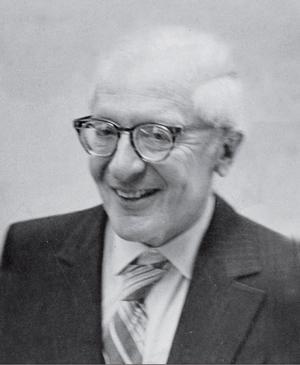
John "Jack" Bernard Jago Trelawney, prominent California mineral collector, was born in Livorno, Italy on April 1, 1909, the son of Harriet Benfield and a Cornishman by the name of Trelawney (?). His parents soon divorced, and his mother took him to live in Palo Alto, California, where he distinguished himself in school and proved to be a child prodigy at the piano. In 1924 his mother sent him to a boarding school in Switzerland. Bilingual from the start in English and Italian, he eventually developed fluency in French, Spanish, German, Greek and Latin, not to mention a passable knowledge of Portuguese, Russian, Japanese, Chinese and a few African dialects.Jack returned to California to attend college, and received his law degree from Stanford in 1933, then worked for the National Recovery Agency (NRA) in Washington, DC. During the war he worked for Military Intelligence, decoding and translating Japanese messages. After the end of hostilities he settled in San Francisco where he resumed his legal career. In the late 1960s he phased out his law practice and traveled the world extensively, finally settling back in Palo Alto, where he lived the last 29 years of his life. In 1972 he legally changed his name from John Bernard Jago to John Jago Trelawney—with no explanation regarding the source of the Trelawney name.
Jack's first mineral specimen was a gismondine given to him when he was six years old, but his main first exposure to mineral collecting came when, as a boy, he received a gift of a boxed mineral collection assembled by Palo Alto dealer Robert M. Wilke. Thereafter Jack became a regular at Wilke's shop, and also the trailer-shop of Chuckawalla Slim (Edward Vose). In later years, after revitalizing his interest in minerals in the 1940s, he immersed himself in the study of mineralogy, took mineralogy courses from Adolph Pabst at U.C. Berkeley, and even hired Brian Mason to tutor him in optical mineralogy.
In 1950, Jack enlisted George Burnham (who had only just started his mineral business in Monrovia) to join him on a trip to buy and collect minerals and visit mineral museums. They collected fluorite at St. Lawrence, Newfoundland and zeolites in Iceland. In Norway they visited Kongsberg, Evje and Kragero and in Sweden they stopped at Långban, then moved on to visit museums in Brussels, London, Cornwall and Paris. This was followed by more collecting at the Lengenbach quarry in Switzerland, a visit to the museums in Florence and Rome, and a stop in Greece before moving on to Egypt and Uganda. At this point George took a different route while Jack visited Madagascar and the Belgian Congo, finally meeting in Johannesburg, South Africa, for Christmas. From there, Jack headed home to California, while George continued on to South West Africa (now Namibia) and Brazil..
The new Långban species jagoite was named in his honor in 1957, in recognition of research grants he had given to the Swedish Museum of Natural History for the study of Långban minerals.
In 1977 Jack agreed to transfer his collection of about 4,000 carefully chosen mineral specimens (considered to be one of the finest private collections of its time) to the Smithsonian Institution, and from that point forward he concentrated his collecting energies primarily on fine gemstones. In 1988 he donated his collection of 179 large, colored gems and one colorless diamond to the Natural History Museum of Los Angeles County, and a few years later he presented to the Smithsonian the last 400 specimens from his mineral collection.
Click to images to view larger
To contribute more information please E-mail us at:
minrecord@comcast.net
Citation format for this entry:
WILSON, Wendell E. 2025
Mineralogical Record
Biographical Archive, at www.mineralogicalrecord.com
minrecord@comcast.net
Citation format for this entry:
WILSON, Wendell E. 2025
Mineralogical Record
Biographical Archive, at www.mineralogicalrecord.com
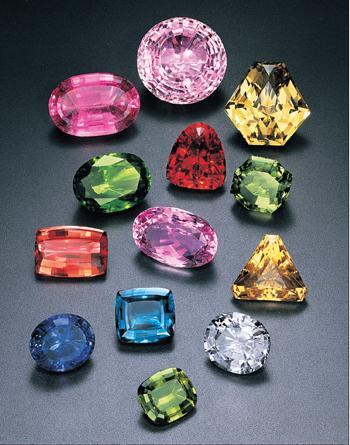
Some of the gems in John Jago’s collection, donated to the Natural History Museum of Los Angeles County.